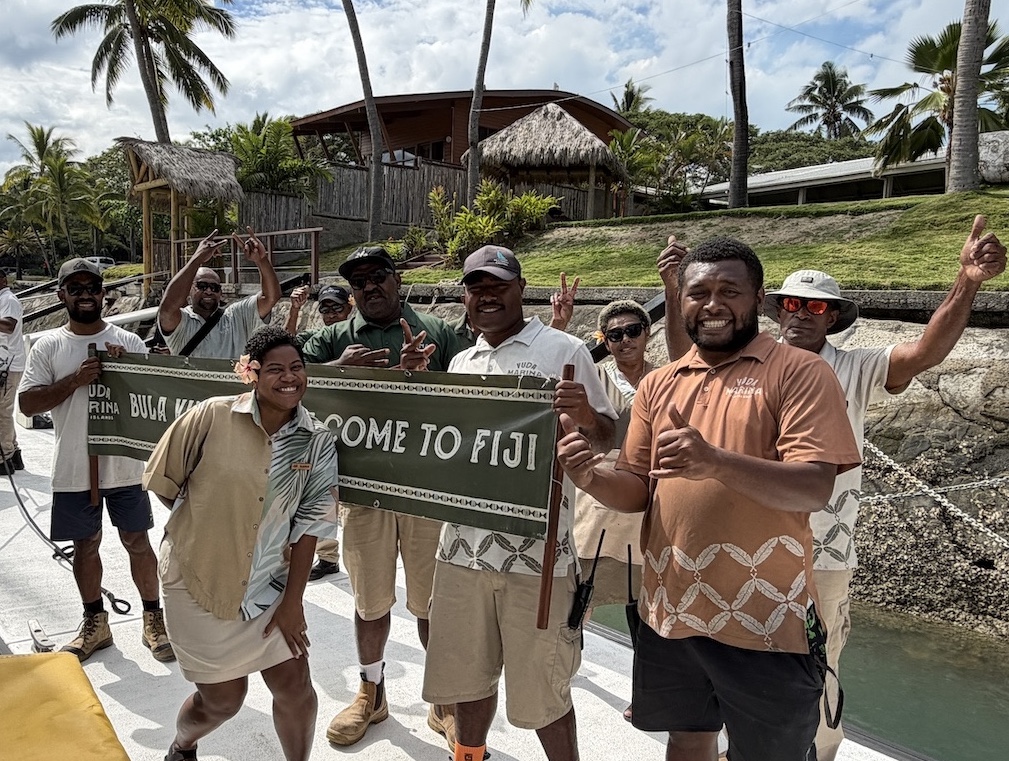
It’s hard to imagine a more welcoming arrival than the song and dance performance we received upon our arrival on the customs dock here at Vuda Point. Smiles and “Bulas!!” abounded. (“Bula” is Fijian for “welcome, hello, greetings”, etc, typically spoken as a whole body expression – imagine a big warm welcoming smile combined with an almost literal bounce in the step). It’s been 11 years since our last time here in Vuda, and while it has grown so very much, it’s wonderful to see that the enthusiasm of the locals has not waned.
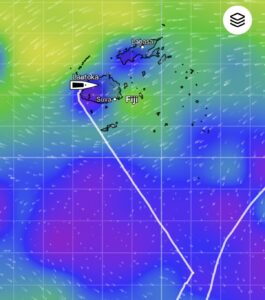
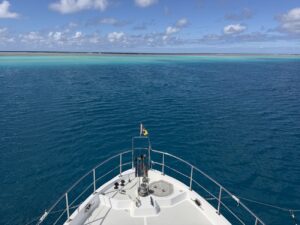
Passage was great and uneventful: three days, 424nm of medium seas on the beam with the wind and seas less than ten kts and one meter respectively over the last 48 hours. However …. and isn’t there always a “however” in sailing ?? We ended up spending one extra night down there in majestic Minerva, when on the way across the lagoon to the pass entrance we discovered that our hydraulic stabilizers would not power up.
Screenshot
Back to the anchorage we went and spent the rest of the day troubleshooting the problem. After calls, emails, etc (big thank you to Graham Baldwin at Innov8v/ABT-TRAC stabilizers, for answering the call on Friday evening of Labor Day weekend) we identified a failed control panel in the pilot house. While we can fix a lot of things, circuit boards are not one of them. In other words, no stabilizers until we can ship in a replacement, clearly not an option in Minerva.
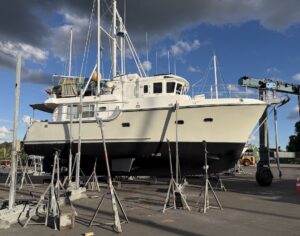
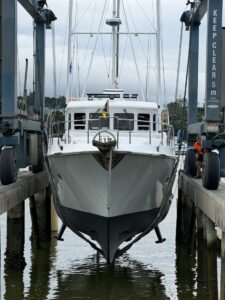
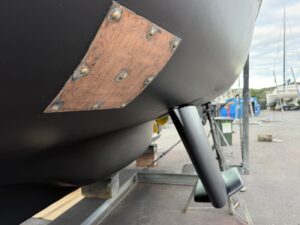
Unlike sailboats with their deep keels, Dragonfly has a shallow and rounded bottom, which means she rolls easily in beam seas. Since our cruising plans call for ocean crossings for extensive periods, far from any shore support, we deemed a backup stabilization system to be critical. Therefore, one of our first projects in refitting Dragonfly before going offshore was to add a passive stabilization system as backup to the hydraulic ABT-TRAC system.
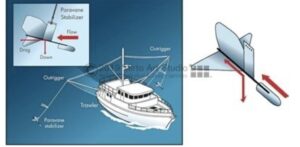
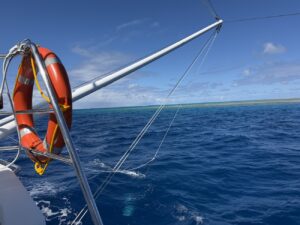
Some Nordhavns are rigged for this, and in fact Dragonfly already had the mast and outrigger poles. But she lacked the paravanes, or “fish”, which are lowered 15-20 feet below the waterline from the end of the outriggers while underway. These “fish” dampen the roll by providing hydrodynamic drag when the boat tries to roll, resisting upward pull of the roll while the opposite fish dives deep to counter the roll back to the other side.
Screenshot
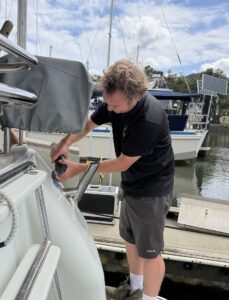
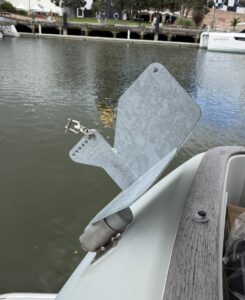
Getting Dragonfly fully rigged for paravanes took a small village. A special thank you to Dougal Gardyne for your extensive ideas, suggestions and guidance for an ideal rig configuration on a Nordhavn, and also hints for effective and safe retrieval and trailing techniques. We got the fish spec’d, designed and manufactured in the US (thank you Kolstrand for your attention to detail and speedy eight week turnaround). Next we lugged their 80 lbs of stainless steel to NZ in our checked luggage bags, then got busy retrofitting Dragonfly’s transom to carry the fish when not deployed.
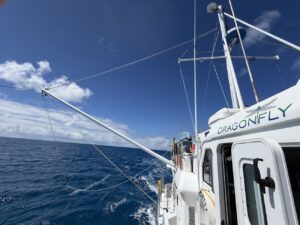
Finally we needed to tailor Dragonfly’s rig to handle the forces of these “flying fish”. This meant replacing all of the standing rigging on Dragonfly to handle the forces – foreguys, afterguys, stays and topping lifts. Finding a NZ rigger who would work on this “weird” power trawler’s rig was a bit challenging. So we owe another special thanks to Buddha of NZ Yacht Services for fearlessly getting her re-rigged while we were back in Idaho this summer. We’d also like to give a shout out to our dock mate Alan Milton, who actually allowed the riggers to drop the outrigger into his slip and stand on his trawler for access during the rig work. Very gracious!
All of that work paid off. We had yet to “beta test” our rig, so we used that extra day in Minerva to talk through and test our plan for deployment and various issues related to retrieval once underway. And voila! – off we went through the pass at Minerva straight into 1-2 m beam seas at less than 7 seconds apart. The fish did their job, the roll was significantly dampened by 60-70%, and we only saw about a half knot decrease in speed due to the extra drag. Very acceptable!
This maiden offshore venture on Dragonfly was a resounding success, and we are loving the stink boat lifestyle!
17 40.9 S 177 23.1 W
Viti Levu, Fiji
1 thought on “BULA ! Landfall Fiji”
Adrienne
That’s a mouthful of new vocabulary! How do you know all this stuff? And figure it out in remote Minerva? Two geniuses I guess who had zero experience on a power boat but problem solvied as needed.
I can always sense the joy, exhilaration, satisfaction and accomplishment in your delightful posts. Living vicariously, Adrienne.






That’s a mouthful of new vocabulary! How do you know all this stuff? And figure it out in remote Minerva? Two geniuses I guess who had zero experience on a power boat but problem solvied as needed.
I can always sense the joy, exhilaration, satisfaction and accomplishment in your delightful posts. Living vicariously, Adrienne.